
Currently Empty: $0.00
August 17, 2026
0
admin
Building a ₹20 Lakh – ₹1 Crore Business as a MindTech Growth Partner
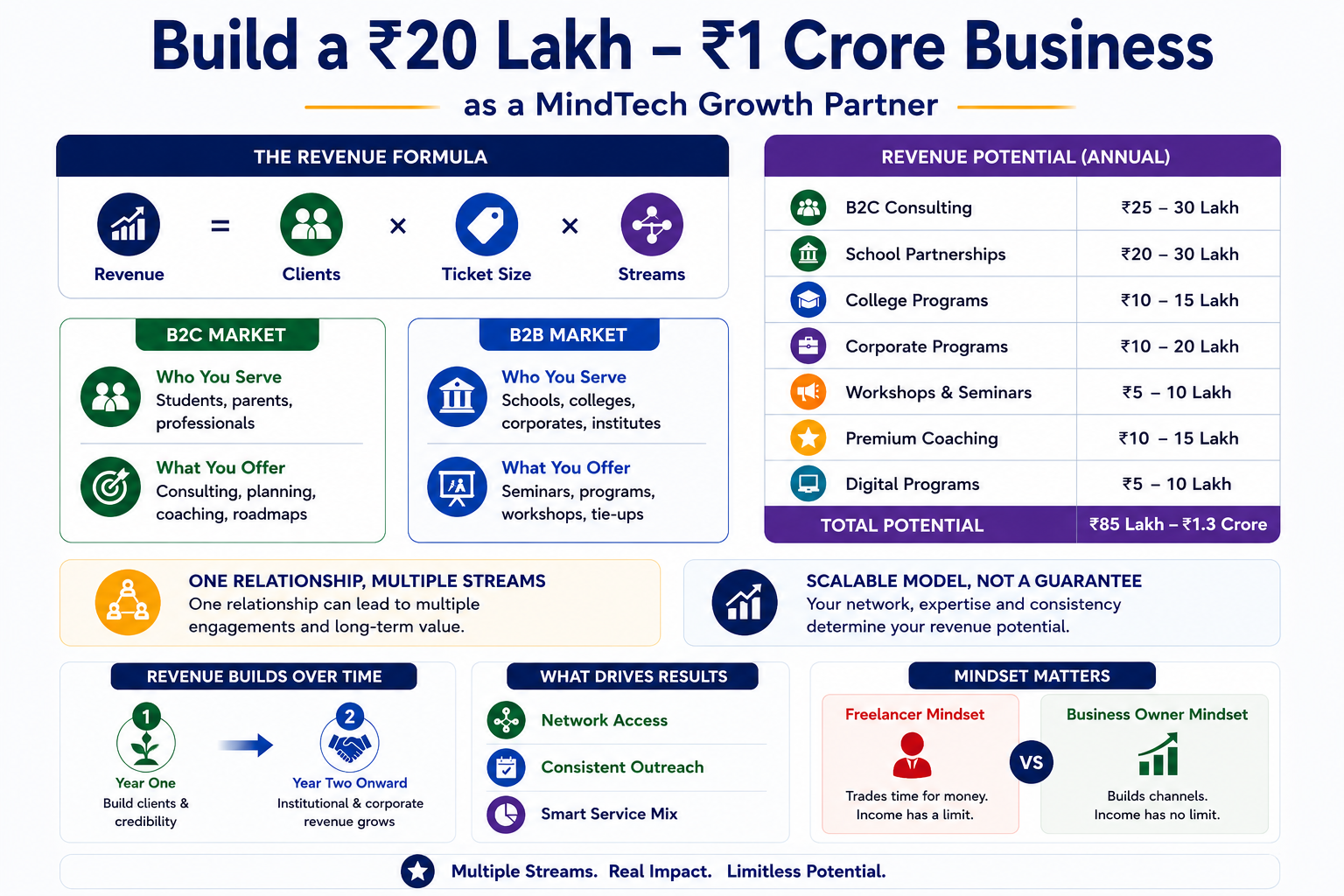
Rather than promising a fixed income, it’s more useful and more credible to understand the actual formula behind a serious MindTech business.
The Revenue Formula
Revenue = Number of Clients × Average Ticket Size × Multiple Revenue Streams
The opportunity isn’t dependent on a single customer type. It splits across two distinct markets that reinforce each other.
The B2C Market: Individuals and Families
Who You Serve
Students, parents, graduates, and working professionals anyone facing a career decision.
What You Offer
Career Intelligence consultation, career planning, coaching, skill development roadmaps, and leadership or personal growth coaching.
The B2B Market: Organizations
Who You Serve
Schools, colleges, universities, coaching institutes, skill development centres, corporate HR departments, and NGOs.
What You Offer
Career awareness seminars, faculty development programs, parent workshops, corporate career development, leadership workshops, and institutional tie-ups.
Why One Relationship Can Generate Multiple Revenue Streams
A single family might become an individual consultation, a parent consultation, and eventually a referral to a school workshop. A single school partnership can lead to student programs, teacher training, and an annual institutional contract. This is what increases customer lifetime value instead of relying on one-time sales.
A Realistic Blended Model
| Revenue Stream | Annual Potential |
| B2C Consulting | ₹25–30 Lakhs |
| School Partnerships | ₹20–30 Lakhs |
| College Programs | ₹10–15 Lakhs |
| Corporate Programs | ₹10–20 Lakhs |
| Workshops & Seminars | ₹5–10 Lakhs |
| Premium Coaching | ₹10–15 Lakhs |
| Digital Programs | ₹5–10 Lakhs |
| Total Potential | ₹85 Lakhs – ₹1.3 Crore |
A Scalable Model, Not a Guarantee
This isn’t a guaranteed income, it’s a scalable business model. As your network, expertise, and client base grow, so does your revenue ceiling. That’s a far more credible pitch than a fixed number, and it’s exactly why serious entrepreneurs respond to it.
How Revenue Typically Builds Over Time
Year One: Establishing the Practice
Early revenue tends to come mostly from B2C consulting and a handful of initial school relationships, while a Growth Partner builds local credibility and a client track record.
Year Two Onward: Institutional Revenue Takes Over
As school and college partnerships mature into recurring annual contracts, and corporate and premium coaching engagements begin, B2B revenue typically starts contributing a larger share of the total and with it, more predictability.
What Determines Where You Land in the Range
Network and Institutional Access
A Growth Partner who already has relationships with schools, colleges, or corporate HR teams typically scales faster than someone starting entirely from a cold network.
Consistency of Outreach
Because revenue depends on the number of clients and partnerships built, the partners who treat business development as a consistent, ongoing activity not a one-time push tend to land toward the higher end of the range over time.
Service Mix Also Plays a Role
Partners who diversify early across B2C, school, and corporate revenue tend to reach the higher end of the range faster than those relying on a single stream, simply because they’re not dependent on any one type of client saying yes.
Thinking Like a Business Owner, Not a Freelancer
The framing matters here. A freelancer trades hours for fees and hits a ceiling the moment their calendar is full. A business owner builds channels B2C, schools, corporates, workshops, coaching that each generate revenue somewhat independently of one another, and each of which can be expanded, delegated, or scaled over time. That mindset shift, more than any single tactic, is usually what determines whether a Growth Partner ends up closer to ₹20 lakh or closer to ₹1 crore.
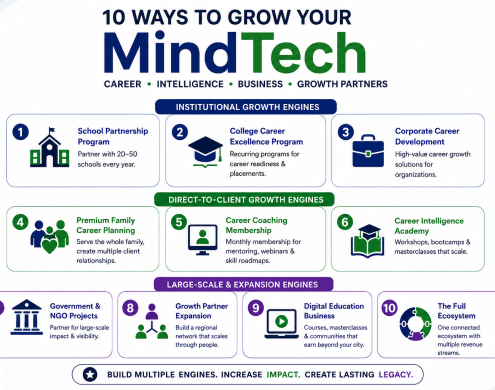
Now that the revenue model is clear, let’s get tactical ten specific ways to grow it.
Leave a Comment Cancel reply
Related Posts
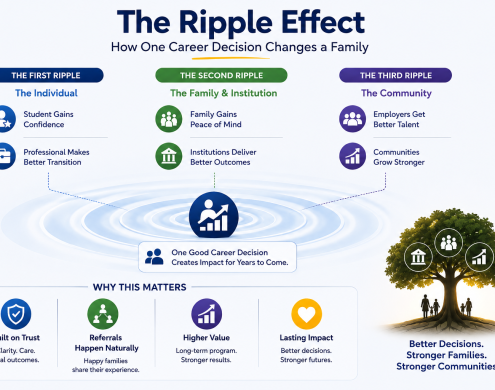
The Ripple Effect: How One Career Decision Changes a Family
August 17, 2026
0
admin
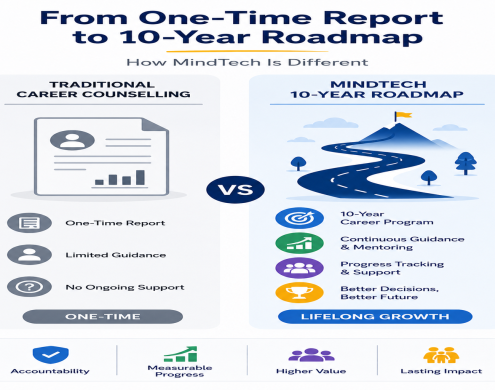
From One-Time Report to 10-Year Roadmap: How MindTech Is Different
August 17, 2026
0
admin