Currently Empty: $0.00
August 17, 2026
0
admin
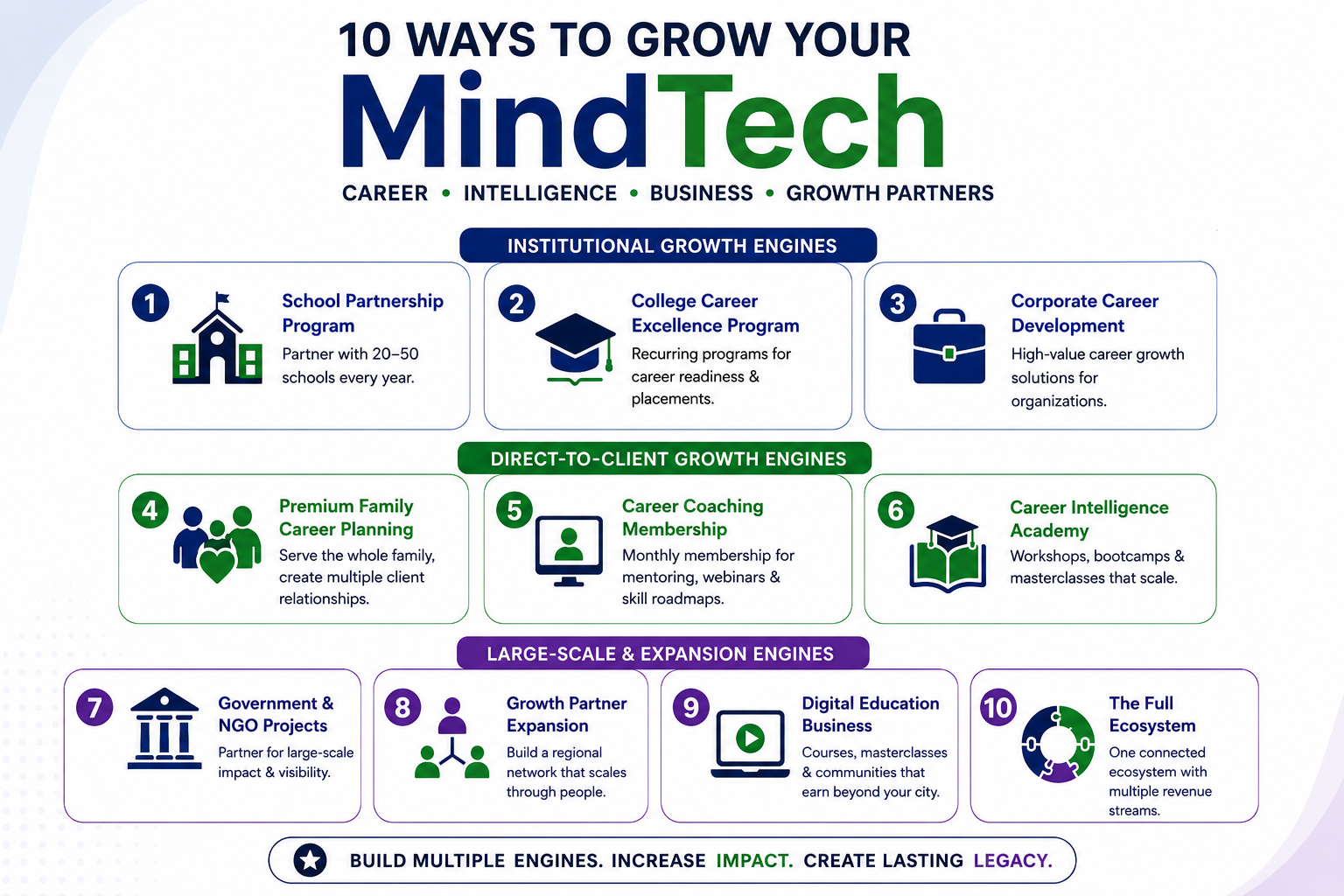
10 Ways to Grow Your MindTech Career Intelligence Business
Growth Partners who scale fastest tend to think less like consultants and more like business owners running multiple revenue engines at once.
Institutional Growth Engines
1. School Partnership Program
Career awareness programs, parent orientation, student career planning, and teacher development with an annual goal of 20 to 50 schools.
2. College Career Excellence Program
Career readiness, placement preparation, leadership programs, and Career Intelligence workshops, structured as recurring institutional contracts.
3. Corporate Career Development
Employee career growth, leadership development, career transition support, and internal talent planning high-ticket B2B work with strong margins.
Direct-to-Client Growth Engines
1. Premium Family Career Planning
Serve the whole family, not just the student student, parent, sibling, and working professional. One household can become multiple clients.
2. Career Coaching Membership
A monthly membership including Q&A, live webinars, skill roadmaps, and mentoring built for recurring, predictable revenue rather than one-off fees.
3. Career Intelligence Academy
Weekend workshops, summer camps, career bootcamps, and parent masterclasses high-value group programs that scale beyond one-on-one consulting.
Large-Scale and Expansion Engines
1. Government & NGO Projects
Collaborating with NGOs, skill missions, CSR projects, and educational foundations for large-scale impact and visibility.
2. Growth Partner Expansion
Developing new MindTech Growth Partners and building your own regional network — a business that scales through people, not just hours.
3. Digital Education Business
Online courses, recorded programs, live masterclasses, and career communities that let you earn beyond your city.
4. The Full Ecosystem
Integrating schools, colleges, parents, students, professionals, corporates, and government into one connected practice multiple revenue streams within a single business.
The Common Thread
Don’t rely on a single service. Every additional stream a school contract, a coaching membership, a digital course compounds on the relationships you’ve already built, increasing lifetime value instead of chasing one-off sales.
How to Sequence These Ten Ideas
Start With What You Already Have
Most Growth Partners see the fastest early traction from whichever of these ten already overlaps with an existing relationship a school they know, a corporate contact, a community they’re active in rather than starting cold on a brand-new channel.
Add Recurring Revenue Next
Once B2C and institutional consulting are generating steady income, layering in a coaching membership or academy program adds predictability without requiring a completely new client base.
Scale Through Leverage Last
Growth Partner expansion and digital education are the two ideas on this list that scale beyond your personal time and geography worth building toward once the core business is stable, rather than starting with them.
Avoiding the Common Mistake
The biggest mistake among newer Growth Partners isn’t picking the wrong revenue stream — it’s trying to run all ten at once before any single one is generating consistent results. A focused sequence, built on existing strengths, tends to outperform a scattered approach every time, both in the results it produces and in how sustainable it feels to run day to day.
Reviewing and Adjusting the Mix
None of these ten ideas are meant to be locked in forever. As a practice matures, it’s worth periodically reviewing which streams are actually producing results relative to the time they take, and shifting focus accordingly doubling down on what’s working, and either fixing or dropping what isn’t. Growth Partners who treat this as an evolving portfolio, rather than a fixed plan set on day one, tend to build more resilient businesses over the long run.
This is what separates a Growth Partner earning steadily from one building something much larger which brings us to the final, and most important, idea: legacy.
Leave a Comment Cancel reply
Related Posts
Building a ₹20 Lakh – ₹1 Crore Business as a MindTech Growth Partner
August 17, 2026
0
admin
The Ripple Effect: How One Career Decision Changes a Family
August 17, 2026
0
admin
From One-Time Report to 10-Year Roadmap: How MindTech Is Different
August 17, 2026
0
admin